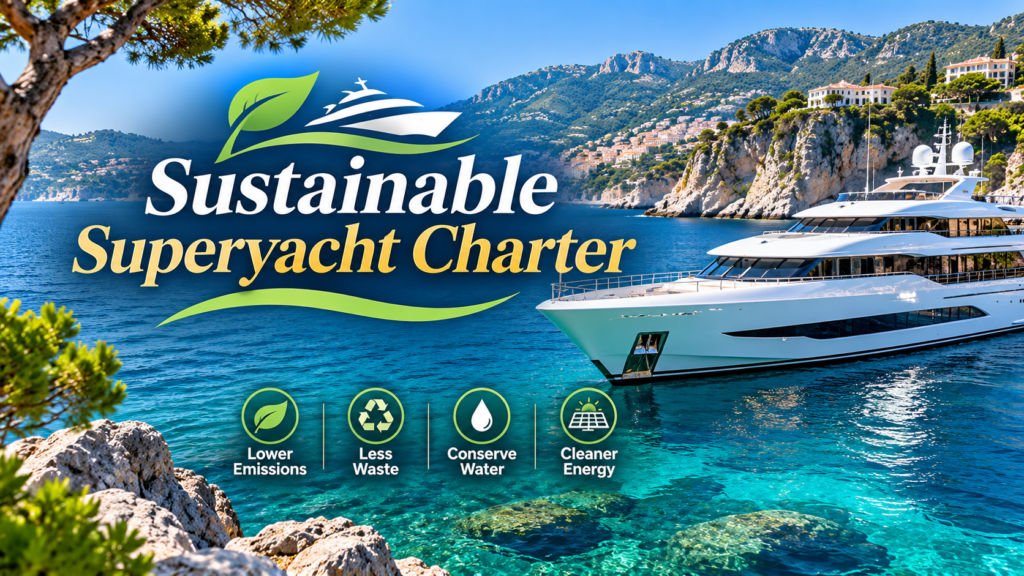
A Mediterranean superyacht charter and sustainability used to sit in different conversations. One was about pleasure, the other about restraint, and the two did not obviously belong together. That has changed, partly because the Mediterranean itself has forced the issue: it is a small, enclosed sea, heavily used, and the effects of busy summers are visible in crowded anchorages, worn seabeds, and ports that feel the strain. Charterers have more influence over it than they might expect.
None of this requires giving up the things that make a charter worth doing. The greener choices on a yacht are mostly practical ones: slower speeds, better routing, careful anchoring, less plastic, local food, and shore power in port. They save fuel, save money, and often make the week more pleasant.
Fuel, speed, and routing: where the savings are
Fuel is the largest environmental cost of a motor yacht charter, and speed is the largest driver of it. Fuel burn rises sharply as speed increases, so a small reduction in cruising speed can cut consumption noticeably over a week, with almost no effect on the itinerary. A good captain plans passages at efficient speeds, times departures to avoid punching into a head sea, and groups the route so the boat is not retracing its path.
Routing matters too. The Mediterranean is full of short hops, and a well-planned week avoids long, fast runs between distant ports. Staying in one cruising ground, the Riviera, the Balearics, the Ionian, or the Aegean, and exploring it properly uses less fuel than trying to cover two regions in seven days, and it makes for a better week as well. For anyone considering chartering a superyacht in the Mediterranean, the single most useful question is how the route is built: around the places you want to see, or around the fuel it takes to see them.
Anchoring and the seabed
The most visible environmental issue in Mediterranean anchorages is the seabed. Posidonia, the seagrass that grows in shallow water around much of the coast, holds the sand in place, shelters young fish, and stores carbon. Anchors and chains drag through it, and a meadow that took decades to grow can be scarred in a single afternoon. Many popular bays now have mooring buoys, which let a yacht tie up without dropping an anchor at all, and where buoys are not available, a careful captain will anchor on sand, away from the meadow.
Regulation is catching up. Parts of the Balearics, the French coast, and several Italian marine parks now restrict anchoring over seagrass or require the use of designated areas, and the rules change from season to season. Ask whether the yacht uses mooring buoys where they exist and how the captain chooses an anchoring spot.
Waste, water, and provisioning
A yacht produces the same waste as a small household, concentrated into a few days and a small space. The good boats handle it with systems, not good intentions: separated recycling, glass and cans kept apart, food waste managed properly, and nothing over the side that should not be there. International rules already ban the discharge of plastics and restrict much else, and most crews take that seriously. The difference between boats is in the details: refillable water bottles instead of cases of plastic, bulk containers instead of single portions, and a galley that plans provisioning so little food is wasted.
Water deserves the same attention. Most modern yachts make their own fresh water with a watermaker, which removes the need to load plastic bottles, but making water uses energy, so mindful use still matters. Short showers, full laundry loads, and a crew that fixes a dripping tap promptly all add up. Provisioning locally, in the markets of the ports you visit, cuts packaging and transport, and it usually means better food.
Efficient hulls and hybrid options
The boat itself matters. Newer yachts are designed with more efficient hulls, lighter construction, and better insulation, all of which reduce fuel use for the same speed and comfort. Hybrid and diesel-electric propulsion, which lets a yacht run quietly on battery power at anchor or at low speed, is becoming more common, and solar panels now appear on more yachts than they used to, topping up the batteries and reducing generator hours. None of this makes a large motor yacht low-impact in absolute terms. It does make a real difference over a season, and it makes the time at anchor quieter and cleaner, which guests notice immediately.
Shore power is the simplest win of all. When a yacht is tied up in port, plugging into the shore supply lets the crew switch off the generators, which cuts noise, fumes, and fuel use at a stroke. Not every berth offers a suitable connection, and the crew will know which ones do. Ask whether the yacht uses shore power in port.
Planning a Mediterranean superyacht charter with a lighter footprint
Before you book, ask a handful of direct questions. How is the route planned, and can speeds be adjusted to save fuel? Does the yacht use mooring buoys where they exist? What is the waste and recycling system on board? Is drinking water refilled rather than bottled? Does the yacht use shore power in port? A good operator will answer all of this without defensiveness and will probably have more to add. The answers matter less as a scorecard than as a signal: this is an operation that pays attention, and operations that pay attention run better charters in every other respect too.
The Mediterranean will always be a busy sea, and a charter will always use resources. The aim is not perfection. It is to take the week you want, on a boat that is run thoughtfully, in a sea that stays worth coming back to. That is a reasonable ask, and it is increasingly what the best operators offer as standard.