 By Admin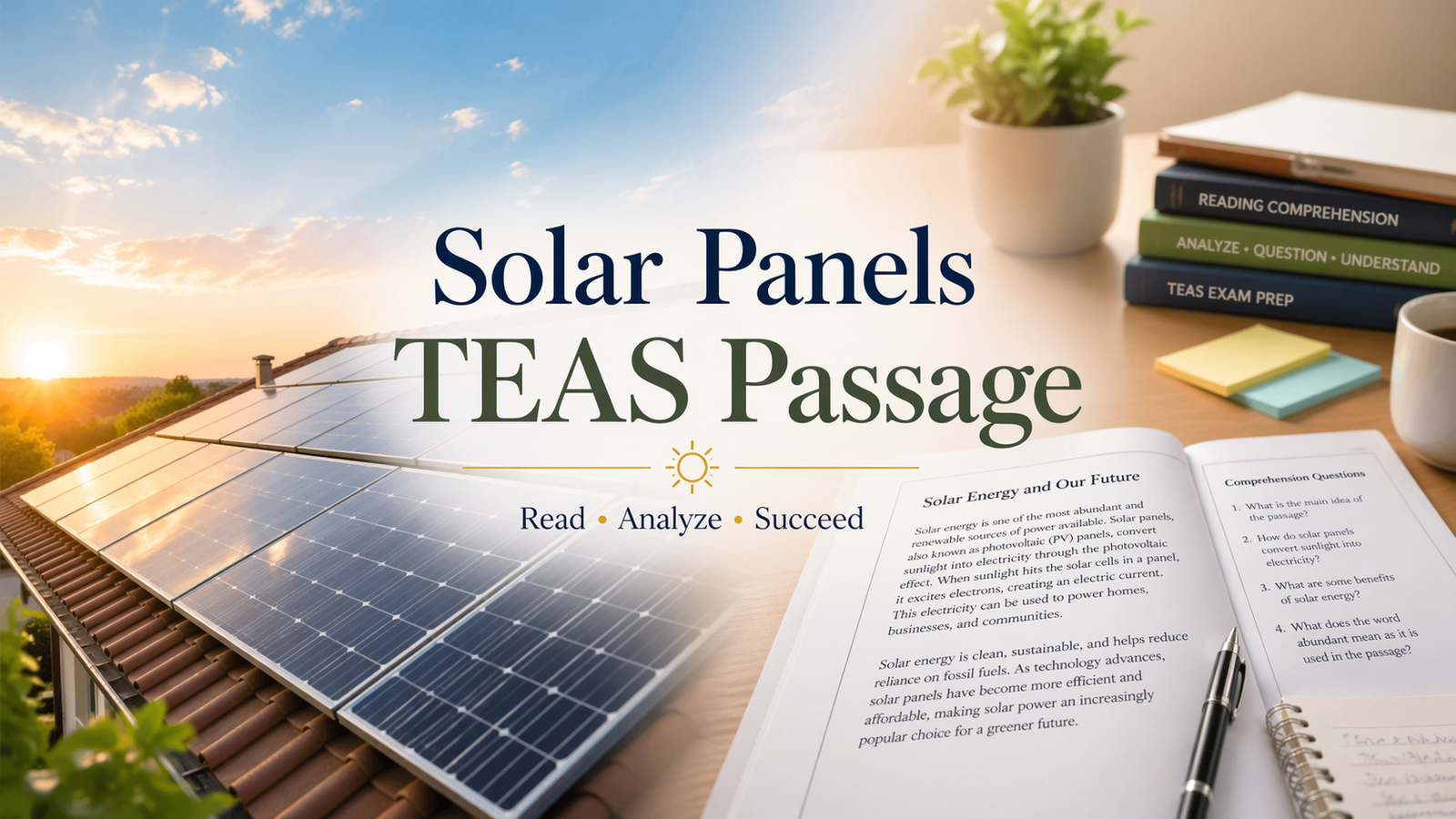
Sometimes a keyword looks a little odd at first glance. This one does. “Solar panels TEAS passage” isn’t a standard engineering phrase, and it’s not something solar installers usually say. It’s mostly used online to describe a reading passage about solar panels that helps students practice comprehension, main ideas, sequence, inference, and technical vocabulary. And honestly… that makes sense. Solar panels are a perfect reading topic because they mix science, money, policy, and everyday life in one small passage.
At the center of most of these passages is a simple idea: solar panels convert sunlight into electricity. The U.S. Department of Energy explains that photovoltaic, or PV, materials turn sunlight into electrical energy, and panels are made by connecting many individual cells together. When sunlight hits the panel, the PV cells create electrical charges, and that flow becomes usable electricity. Pretty elegant, really. Not magic. Just good science.
Why solar panels show up in TEAS-style reading passages
There’s a reason teachers and test makers like this topic.
- It explains a real-world technology in clear language
- It includes process words like convert, absorb, generate, and store
- It allows questions about cause and effect
- It often mixes history with science
- And it gives room for inference questions, not just basic facts
A lot of current pages using this keyword say the same thing in different ways: the passage is used to test how well a reader can understand technical information without getting lost in jargon. That’s a useful skill far beyond any exam.
A simple table to understand the topic better
Here’s a quick breakdown of what a solar panels TEAS passage usually covers:
| Passage Focus | What the reader is expected to understand | Why it matters |
|---|---|---|
| Main idea | Solar panels turn sunlight into usable energy | Tests overall comprehension |
| Sequence | Sunlight hits cells, electricity is generated, inverter changes DC to AC | Tests process understanding |
| Vocabulary | Terms like PV cells, inverter, grid, storage | Tests context clues |
| Benefits | Lower dependence on fossil fuels, possible bill savings, cleaner energy | Tests supporting details |
| Limits | Upfront cost, weather dependence, roof or space needs | Tests balanced reading |
| Historical examples | White House solar panels under Carter and later presidents | Tests timeline and inference |
That structure matches both the way solar technology is explained by DOE and the way current keyword-targeted pages frame the topic for reading practice.
The White House example — and why people remember it
One reason this topic keeps appearing in study material is the White House solar panel story. It’s memorable. It has history, politics, energy policy, and symbolism all packed into one short narrative.
The White House Historical Association notes that President Jimmy Carter had 32 thermal solar collectors installed on the roof of the West Wing in 1979. They were meant to heat water for the White House staff mess and reflect a broader push toward alternative energy during the energy crisis era. Those panels were later removed in 1986, and solar technology was reinstalled at the executive mansion under later administrations, including George W. Bush and Barack Obama. That timeline makes the passage great for test questions about sequence, tone, and changing priorities.
And yes, this exact White House angle appears in current TEAS-related study materials online. Those pages typically frame the passage around presidents, energy conservation, and the return of solar panels to the White House roof.
How solar panels work, in plain English
Let’s strip it down.
A solar panel contains photovoltaic cells. These cells absorb sunlight. That sunlight knocks electrons into motion, which creates an electrical current. The electricity generated is usually direct current, or DC, and an inverter changes it into alternating current, or AC, which homes and buildings commonly use. If the system makes extra power, that electricity may go to the grid or into battery storage, depending on the setup.
That’s why solar passages are so useful in reading practice. They explain a process step by step. If you can follow the sequence, you can answer half the questions already. Maybe more.
What makes a strong answer to a solar panels passage?
When someone reads a passage on solar panels, the best answers usually come from slowing down and noticing what the writer is really doing.
Look for these things:
- Main idea first: Is the passage mainly about how solar panels work, why they matter, or how they were used in history?
- Signal words: Words like because, however, later, and as a result usually point to the question type
- Supporting details: A number, a date, or a technical term may support the main point without being the main point itself
- Tone: Informational passages sound neutral, even when the topic is exciting
- Inference: Sometimes the answer isn’t directly stated. You have to connect the dots a little
But here’s where many readers trip up: they focus too much on one flashy detail. A president’s name. A date. A cost figure. And they miss the real purpose of the passage. That’s a classic mistake.
The bigger reason this topic matters
Solar panels are not just test-prep material. They matter because solar energy is now a real part of how homes, businesses, and even public institutions think about power. DOE explains that savings from solar depend on factors like electricity use, system size, financing, roof direction, and local utility rates. Storage can also make solar more flexible by saving power for later use, including nighttime or outages. So the topic feels academic on the page, but it’s also very real outside the classroom.
There’s even another possible reading of this keyword online: a few pages connect “solar panels teas passage” to tea farming and agrivoltaics. That meaning is much less common in current search results, but the idea itself is real. Agrivoltaics combines solar and agriculture on the same land, which research groups like NREL describe as a way to produce energy while still supporting crops or other agricultural uses. Interesting side path, honestly. Just probably not the main one behind this keyword.
Final thoughts
So what is “solar panels TEAS passage” really about?
In practical terms, it usually means a reading passage that uses solar energy as the subject to test comprehension skills. The topic works well because it’s clear, useful, and layered. You can learn how solar panels work, follow a historical example like the White House story, and practice reading skills at the same time. Not bad for one small passage.
And maybe that’s why the phrase keeps showing up. It sounds niche. A little awkward too. But behind it is a solid idea: understand the passage, understand the process, and the answers get easier. Bit by bit, line by line.